The EU had 331 unicorns in 2025. The US had 1,963. That gap isn't mostly about talent or capital — it's about structure. EU Inc's proposal, published March 18, 2026, contains specific mechanisms designed to fix three concrete problems that have made scaling a startup in Europe structurally harder than in the US or UK. Here's what's actually in the proposal.
The structural problem EU Inc is solving for startups
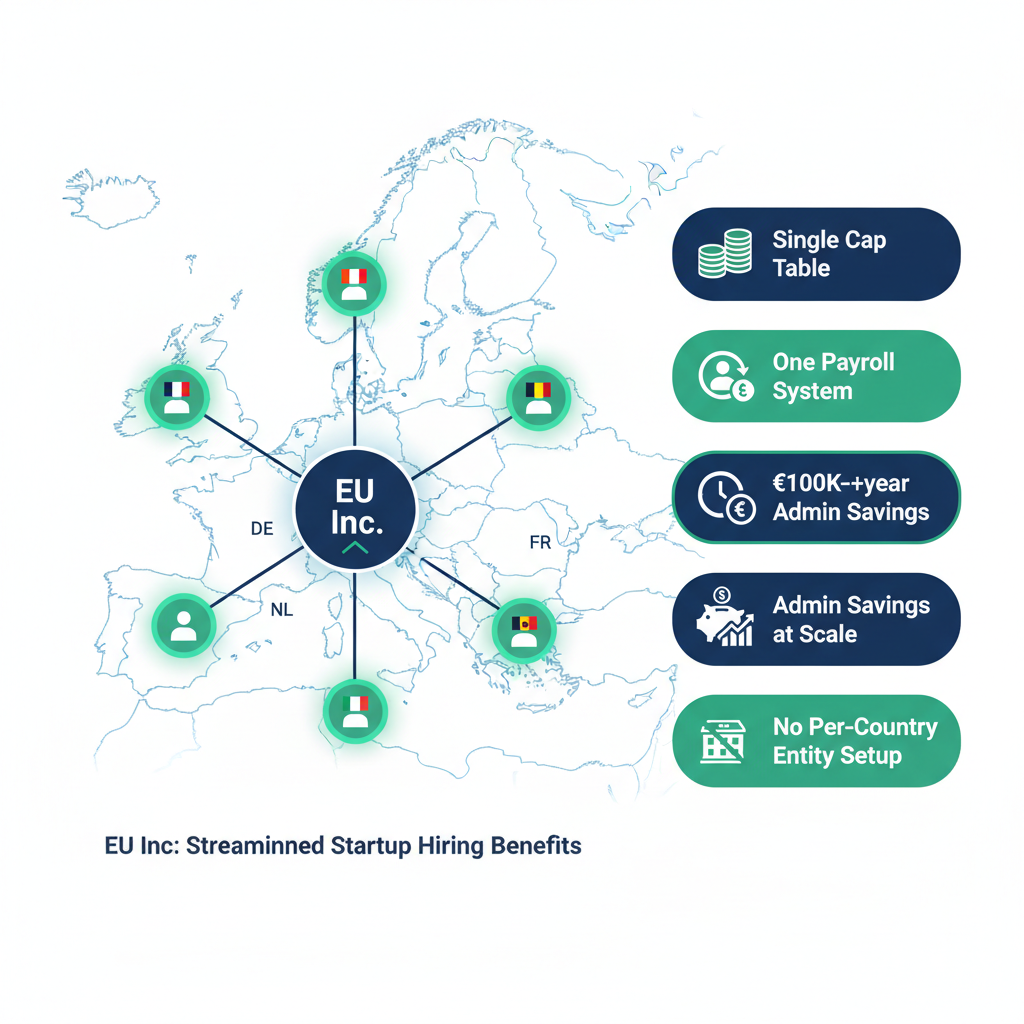
Right now, a startup that wants to raise a Series A from a German fund, hire an engineer in Poland, and sell to French enterprises faces this reality: three different legal systems, three sets of compliance rules, and three separate legal entities if it wants to operate cleanly. The average European scaleup spends an estimated €180,000–€300,000 in cross-border legal costs before Series B. That's money that should be going into product.
The proposal is explicit about this. The European Commission's own data cited in the proposal's impact assessment shows that fragmentation is one of the primary reasons European startups choose to incorporate in Delaware instead of staying in Europe — a trend that accelerates as companies approach Series A.
The three things EU Inc actually does for startups
1. Employee Stock Options that work across borders (EU-ESO)
This is the most technically significant part of the proposal for early-stage companies, and the most underreported.
Today, issuing stock options to employees across multiple EU countries is a legal and tax nightmare. Each country has different rules on when options are taxed (at grant, at vest, or at exercise), different valuations for strike price purposes, and different social security treatments. A startup with employees in Germany, France, and the Netherlands effectively needs three separate equity plans.
EU Inc introduces the EU-ESO (EU Employee Stock Ownership) framework. The key provision: options are taxed only at the moment of sale — not at grant, not at vest, not at exercise. This is the standard that made ESOP culture possible in Silicon Valley, and it's been absent from European company law.
- →Applicable to all employees and board members of an EU Inc company
- →Taxed only at disposal of underlying shares — not at grant or exercise
- →Single harmonized framework replacing national-by-national plans
- →Source: Clifford Chance briefing March 24, 2026 + EC press release IP/26/614
2. SAFEs, convertible instruments, and investor-friendly financing
The proposal explicitly allows EU Inc companies to issue SAFEs (Simple Agreements for Future Equity), KISS notes, warrants, and redeemable shares. This is a significant departure from most European company law frameworks, which either don't recognize these instruments or require complex legal workarounds to implement them.
The practical implication: a European startup raising a pre-seed round can issue a SAFE note to an angel investor using the same instrument that US investors are already familiar with — without a Delaware flip, without a parallel US entity, and without the legal cost of translating the instrument into local law.
The proposal also allows shares with multiple voting rights. Founders can maintain control while bringing in institutional investors — a structure that's standard in the US but has historically required workarounds in most EU jurisdictions.
3. One registration, 27 markets
Registration in 48 hours, maximum €100, via the BRIS digital interface. No notary. No local representative in each country. The "once-only" principle means you submit information once and it propagates digitally to tax authorities, social security systems, and beneficial ownership registers.
For a startup expanding from Italy to Spain: no separate Spanish SL, no Spanish legal counsel for incorporation, no physical presence requirement for formation. The EU Inc entity operates in Spain as it does in Italy — same legal structure, same compliance framework.
What EU Inc doesn't solve (be honest with your investors)
The proposal has real gaps that the startup community has already flagged, most notably in a Pitchbook analysis that called it a step forward but "not yet the Delaware of Europe."
- Tax harmonization — corporate tax rates stay national. Ireland's 12.5% and Germany's ~30% effective rate remain different.
- Labor law — employment rules remain per-country. Hiring a full-time employee in France still means French labor law.
- Legal certainty for VCs — no equivalent of Delaware's Court of Chancery. Investor protections and shareholder agreements will still have to navigate national legal systems in disputes.
- Not available yet — earliest realistic availability: late 2027 in the first implementing countries.
EU Inc vs Delaware: the honest comparison
| Factor | Delaware C-Corp | EU Inc (proposed) |
|---|---|---|
| Incorporation cost | $50–500 + legal | max €100 |
| Time to incorporate | 1–3 days | 48 hours |
| Employee equity (ESOP) | ✅ Mature, well understood | ✅ EU-ESO (new, harmonized) |
| SAFEs / convertible notes | ✅ Standard | ✅ Explicitly included |
| Multiple voting rights | ✅ Standard | ✅ Allowed |
| Legal certainty in disputes | ✅ Court of Chancery | ⚠️ National courts (varies) |
| Tax harmonization | ✅ Federal tax system | ❌ National rates apply |
| VC familiarity | ✅ Universal | ⏳ Building (new framework) |
| Geographic scope | US market (+ foreign qual.) | 27 EU member states |
The practical question: Delaware flip or EU Inc?
Many European startups raising from US VCs still do a "Delaware flip" — converting their EU entity into a US C-Corp to make the cap table readable for American investors. The question is whether EU Inc changes that calculus.
Honestly: for startups targeting primarily US institutional capital, the Delaware flip will remain attractive in the short term. EU Inc doesn't replicate Delaware's legal infrastructure or its investor familiarity.
But for startups targeting European VCs, European enterprise customers, or building primarily within the EU market — EU Inc is a much cleaner solution than the current patchwork of national entities. And as EU Inc builds track record and legal precedent, the gap with Delaware will narrow.
What to do right now
You can't register yet. But you can do three things that matter:
- Audit your current structure. If you're using a national entity for European operations, identify where EU Inc would reduce complexity once available.
- Talk to your legal counsel about EU-ESO. If you have employees across EU countries, the EU-ESO framework could significantly simplify your equity program. Start the conversation now, not when the law passes.
- Stay on top of the timeline. The Commission has asked Parliament and Council to reach agreement by end of 2026. If that holds, early 2027 could see the first implementing regulations.
FAQ
Can EU Inc raise VC funding as easily as a Delaware C-Corp?
For European VCs: likely yes, once the framework has track record. For US VCs: probably not initially, because of unfamiliarity with the legal framework and the absence of a US-equivalent court system for shareholder disputes. The gap will narrow over time, but it's real today.
Does EU Inc support SAFEs for pre-seed fundraising?
Yes, explicitly. The proposal includes SAFEs (Simple Agreements for Future Equity), KISS notes, and other convertible instruments as recognized financing tools for EU Inc companies. This is a major change from most national European frameworks.
Can I convert an existing startup (SRL, GmbH, SAS) to EU Inc?
Yes. Article 14 of the proposal explicitly allows creation of a EU Inc through conversion of an existing national entity. You won't need to dissolve and reconstitute from scratch.
What's the realistic timeline for EU Inc to be available?
The Commission is asking for agreement between Parliament and Council by end of 2026. Realistically, the first countries could implement it by late 2027. Not all 27 member states will be ready simultaneously — some will move faster than others.
Does EU Inc replace the need for a Delaware entity for European startups?
For startups targeting US institutional capital primarily: not in the short term. For startups targeting European VCs and EU market customers: yes, EU Inc should be a cleaner and cheaper solution than either maintaining a Delaware entity or juggling multiple national European entities.